
Your best next customers are the ones you already sold to
Every equipment dealer is sitting on a pile of upgrade revenue, and most of it is invisible. It's the customer who bought a machine from you nine years ago and is one cold morning away from needing a new one. It's the shop running a unit that's failed twice this season. It's the account you haven't called on in two years because nothing prompted you to. None of these show up on a report, so they wait — until the machine dies and the customer calls whoever's top of mind, which isn't always you.
This is the difference between depending on word of mouth and having a second way to make money. Word of mouth is real, and it'll always bring in business. But it's reactive: you get the sale when the customer's machine fails and they happen to think of you. Finding upgrade opportunities in your service history is proactive: you go to the customer before the failure, with a reason, while you're still the one they trust. You stop waiting for the phone to ring and start working the money that's already in your base.
The best part is that you earned the right to this revenue years ago. These aren't cold prospects. They're your customers, with your equipment, who you've already serviced. You just need to see them.
Old machines and expensive ones — those are your list
Signal one: equipment age. Most equipment has a practical replacement window — for many machines, somewhere past eight to ten years the conversation becomes worth having. If you know how old each customer's equipment is, you can build an upgrade list in minutes: everyone past the threshold, sorted oldest first. Age alone is the single strongest predictor, and it's the one most dealers don't track in a way they can sort.
Signal two: rising repair cost. A machine that's needed several service calls in a season, or whose repairs are getting more expensive, is telling you something the customer already feels: it's becoming a money pit. Those customers are often relieved to hear there's a better option, because they've been quietly dreading the next breakdown. Your service history holds this pattern — you just have to be able to see repair frequency and cost per machine over time.
Put the two together and you have a ranked list of real conversations: oldest equipment, highest recent repair cost, at the top. That's not a marketing list. That's a route.
Get equipment age and service history onto one view, then work the list
Here's a tool-agnostic method. You can approximate it by hand from your invoices, or run it cleanly in software built for equipment dealers. The logic is the same.
Step 1 — Pull equipment age for every customer. For each customer, record what they own and when they bought it. If your records only show invoices, you can reconstruct age from the original sale date. The output is a list of machines with an age next to each.
Step 2 — Layer in service history per machine. Tie each service call to the specific machine, so you can see how many times a unit has been worked on and what it cost. A machine with a thick service file and a recent string of repairs jumps out.
Step 3 — Sort by opportunity. Rank customers by equipment age (oldest first), then flag the ones with rising repair costs. The top of that list is where the next sales are.
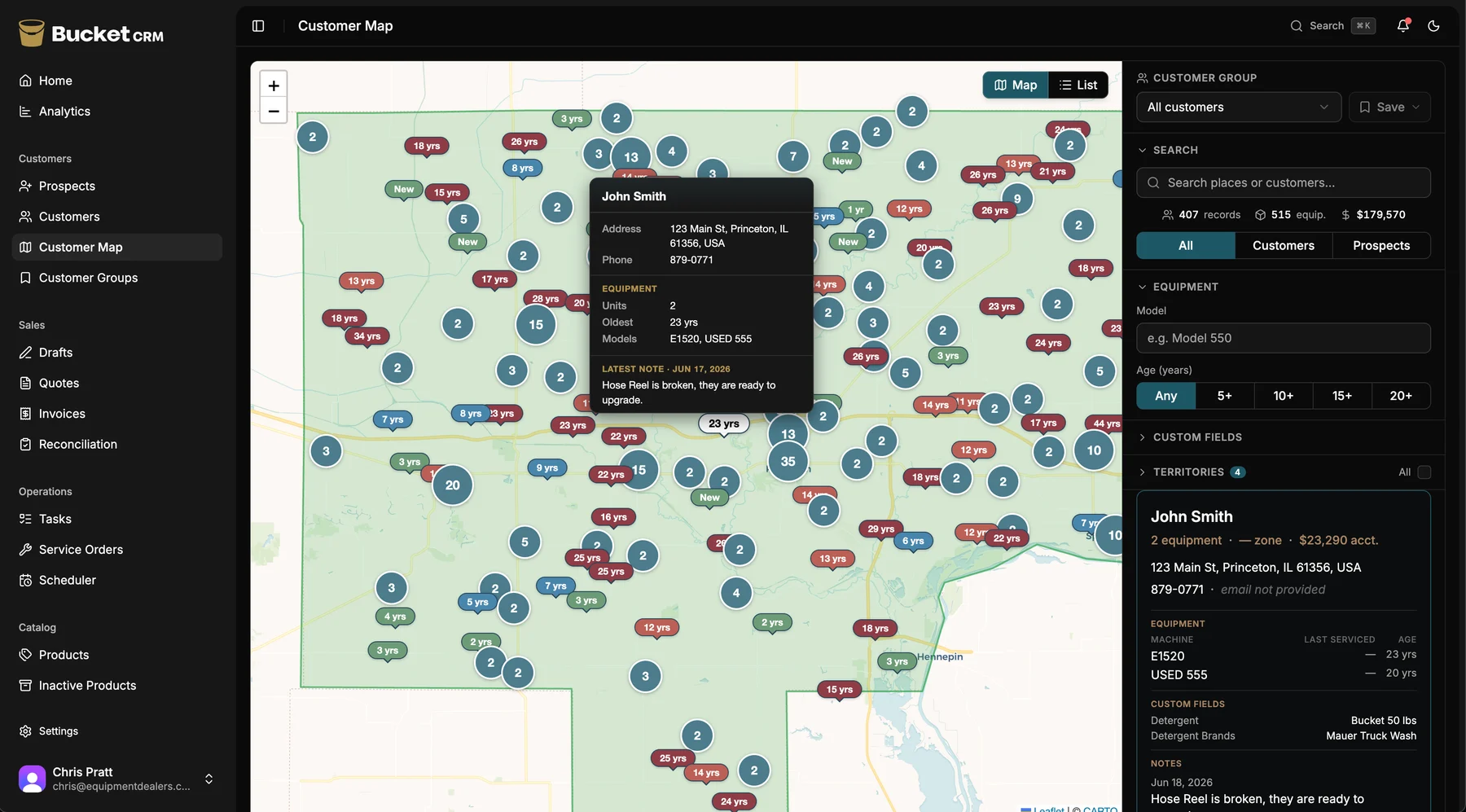
Step 4 — Put it on your territory map. Opportunities you can see get worked; opportunities in a spreadsheet get forgotten. Plot the aging machines on a map of your territory so the upgrade conversations cluster visually and you can route your visits.
Step 5 — Work it before the failure, not after. Reach out while the machine is still running. "I noticed you're coming up on ten years on that unit — worth talking about what's new before it leaves you stranded in the busy season." That's a welcome call, not a sales pitch, because you're saving them a breakdown.
The data exists. Seeing it all at once is the problem.
If this is so valuable, why doesn't every dealer do it? Because the information is scattered. Equipment age is buried in old sales invoices. Service history is in paper work orders, in QuickBooks line items, or in a tech's head. Nobody has a single view that says "here are your customers, sorted by how ready their equipment is to be replaced." Building that by hand, from four sources, is a project nobody has time for — so it doesn't happen, and the revenue waits.
What makes it easy is having equipment age and service history live together on the customer record, and a map that surfaces them automatically. That's exactly what Bucket's Opportunity Map does: your whole customer base, color-coded by equipment age, updating as your techs log service calls — so the upgrade list builds itself and shows up as red pins on your territory. Instead of a quarterly project, finding upgrade opportunities becomes something you glance at every Monday morning.
However you do it — by hand or with software — the payoff is the same: a second, proactive way to make money that runs alongside the calls that come in on their own.