
Back to Bucket

Compare · Bucket vs ServiceTitan

Bucket CRM vs ServiceTitan: which one is right for an equipment dealer?

ServiceTitan is enterprise software built for large commercial and residential trades — big HVAC, plumbing, and electrical operations running dozens or hundreds of technicians out of one or many locations. It is powerful, deep, and priced for that scale: per-technician, quote-only, and usually rolled out over months with help from consultants. Bucket is built for a different business: an equipment dealership with three to twenty people that sells machines and then services what it sold for years afterward. If you run a large multi-location service operation with a big fleet and a budget for enterprise software, ServiceTitan may be exactly right, and you probably don't need the rest of this page. If you're a pressure-washer, generator, compressor, forklift, or outdoor-power dealer with a sales side and a service side under one roof, the rest of this page is for you — because ServiceTitan's size, complexity, and price were designed for a company that doesn't look like yours.

You probably want Bucket if:

  • You sell equipment AND service it under the same roof
  • You're a three-to-twenty-person dealership, not a hundred-tech contractor
  • You want software your techs can use on day one without a training department
  • You'd rather pay for a tool that fits your business than grow into one built for someone ten times your size

You probably want ServiceTitan if:

  • You run a large service operation — dozens to hundreds of technicians
  • You're a commercial or residential trades contractor (HVAC, plumbing, electrical) at scale
  • You have multiple locations and need enterprise-grade reporting and infrastructure
  • You have the budget and the people to run a months-long software rollout

The rest of this page walks through why, with real examples from an equipment dealer's week.
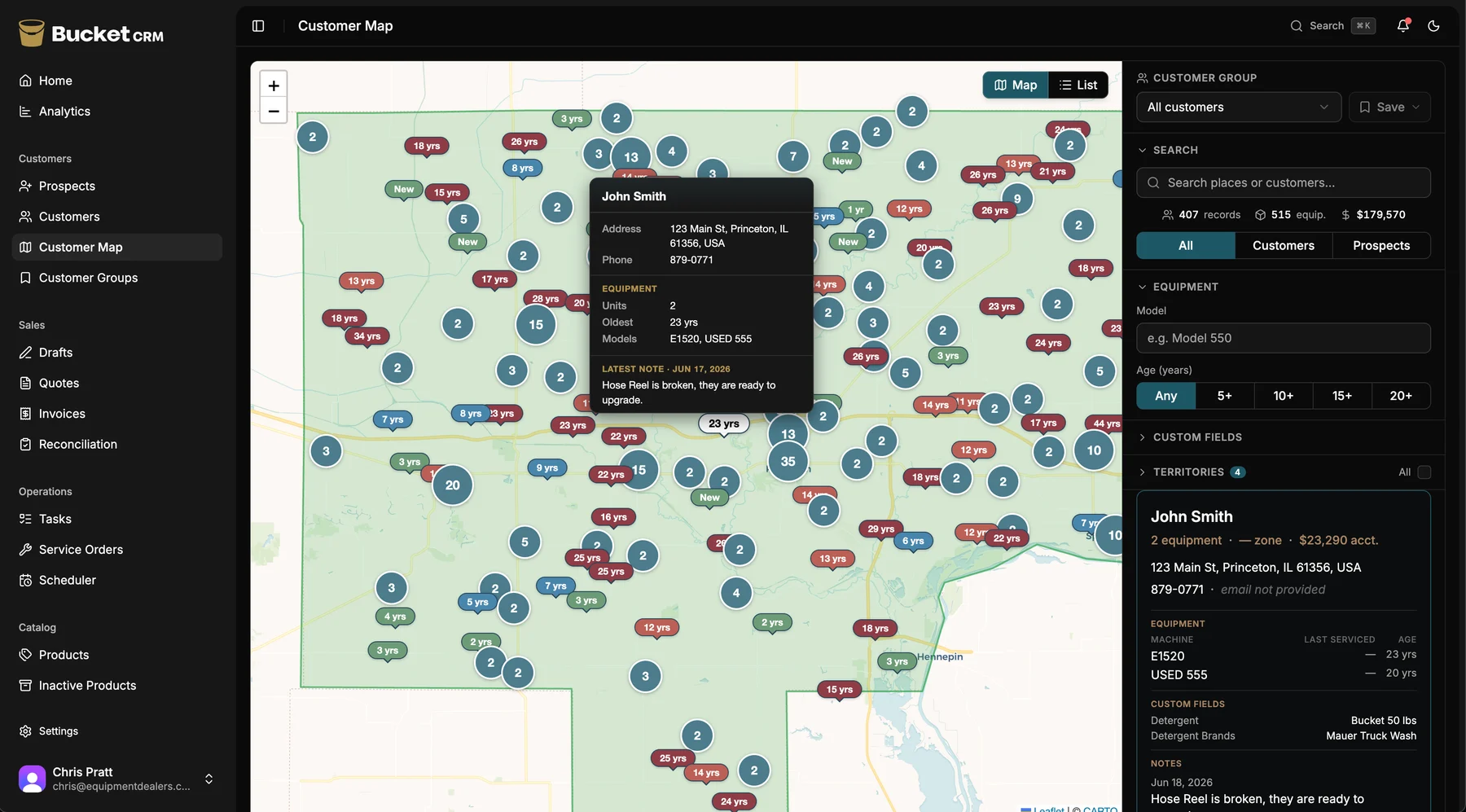
The difference, in one screen

ServiceTitan can't show you this.

The Opportunity Map puts your whole territory on one screen, color-coded by equipment age. Dealer-scale, without ServiceTitan's enterprise weight.

app.mybucketcrm.com
The Opportunity Map — Bucket's dealer-scale territory view, without ServiceTitan's enterprise complexity.

Why this comparison matters

An equipment dealer and a national HVAC contractor are both “field service.” They are not the same size or shape of business.

ServiceTitan is one of the most powerful tools in field service. It runs some of the biggest contracting companies in the country — national plumbing chains, multi-location HVAC operations, commercial electrical contractors with hundreds of trucks. When a company that size needs to coordinate dozens of dispatchers, hundreds of technicians, and millions of dollars of jobs a month, ServiceTitan is built to carry that weight.

Most equipment dealers are not that company. A Hotsy dealer, a generator shop, a compressor distributor, an outdoor-power dealership — these are businesses with three to twenty people. An owner, a few sales reps, a handful of techs, a dispatcher, someone in the office handling the books. They do real volume and they've often been in business for decades, but they are not a hundred-truck commercial HVAC operation, and they don't run like one.

That size difference changes which software actually fits. Enterprise software is built for scale problems: hundreds of users, complex permission structures, deep configurability, custom reporting that a dedicated operations analyst will tune. Those are real problems at three hundred technicians. At twelve people, they're not your problems — they're overhead. You end up paying for capability you'll never use and spending time configuring a system that was built to be configured by someone whose whole job is configuring it.

There's a second difference that matters even more than size. ServiceTitan's DNA is pure service. Its data model is built around the service job — dispatch it, do it, invoice it, collect. That's the right center of gravity for a plumbing company. But an equipment dealer's business has a second half that ServiceTitan wasn't shaped around: you sell the machine first, and then the relationship lives in that equipment for the next ten years. The sale, the equipment, the service history, and the upgrade conversation all have to connect. ServiceTitan can be configured to approximate some of that. Bucket was built for it from the first line of code.

A week in the life

Same week, same dealership, different software.

Let's walk through five real moments in an equipment dealer's week, and what happens in each piece of software. No marketing language. Just what actually happens at your desk, in the truck, and in the back office.

01

Monday morning

Planning the week

On ServiceTitan

You open the dispatch board. It's a powerful screen — capacity planning, technician zones, color-coded job types, the works. It was built to help a dispatcher juggle forty technicians across a metro area. But your shop has four techs and two reps, and planning your week isn't a capacity-optimization problem. It's deciding which customers to go see — who's overdue for a visit, whose equipment is aging into a replacement, where the next sale is hiding. ServiceTitan's dispatch board is brilliant at scheduling the jobs you already have. It doesn't tell you which customers you should be calling on next, because that's a sales question, and ServiceTitan is a service-operations tool at its core.

On Bucket

You open Bucket on your phone. The Opportunity Map shows your whole territory, color-coded by equipment age. Red pins are customers with machines over ten years old — the upgrade conversations waiting to happen. Yellow pins are overdue follow-ups. The map remembers who needs attention so you don't have to run it off memory or a stale spreadsheet. You spend five minutes planning the week, and the customers you visit are the ones most likely to buy. There's nothing to configure first. You just open it and the answer's already there.

02

Tuesday

A customer calls with an equipment question

On ServiceTitan

A customer calls — they bought a unit from you a few years back and it's acting up. You pull up their account. ServiceTitan holds a lot here: job history, invoices, service agreements, call recordings, equipment records if someone set them up consistently. The information is probably in there. The challenge is that “probably in there” depends on how your team was trained to enter it, and how many of the optional fields they fill in on a busy day. Enterprise software gives you a hundred places to put information, which means information ends up in a hundred places. You're clicking through tabs while the customer waits.

On Bucket

You open the customer's record. You see every piece of equipment they own — model, serial, purchase date, full service history attached to each machine. The unit they're calling about shows its age, its last service, and the parts replaced on it. You see one open parts order. You see the account is paid up. You see the rep who originally sold it. The whole picture is on one screen in two taps, because there's essentially one place for it to live. You're back to the customer in twenty seconds — not because Bucket holds more than ServiceTitan, but because it holds less, in fewer places, on purpose.

03

Wednesday

A service tech notices something important

On ServiceTitan

Your tech is at a customer's shop doing a routine service. While he's there he notices their second unit — an older one — is barely running, and it's a strong candidate for replacement. In ServiceTitan, he could log a note, flag a follow-up, maybe even generate a lead if your system is configured for it. But your tech is one of four guys who learned the parts of the app they use every day and not much else. The lead-generation workflow lives three taps deep in a screen he was shown once during a rollout six months ago. So he tells himself he'll mention it to the salesperson — and by the time he remembers, it's two weeks later and the moment's gone.

On Bucket

Your tech opens the service order on his phone. There's a notes field tied to each piece of equipment. He writes “second unit (twelve years old) — barely running, recommend replacement quote” and saves. He didn't need a workflow, a training refresher, or a lead-gen module. That note shows up on the salesperson's customer record the next morning, flagged for attention, and the customer's shop lights up on the Opportunity Map with the note attached. Your service team just handed your sales team a warm lead, and the only thing the tech had to know was where the notes field was — which, by design, is two taps from the home screen.

04

Thursday

The owner wants to know how the territory is doing

On ServiceTitan

You want to know which territories are producing, what your win rate is on quotes by area, and where the open pipeline is sitting. ServiceTitan has some of the most powerful reporting in the industry — custom reports, configurable dashboards, deep analytics. The catch is the word “configurable.” Those reports are powerful because someone built them for your business, and at most large ServiceTitan shops that someone is a dedicated operations or analytics person whose job includes maintaining the reporting. At a twelve-person dealership, that person is you, after hours, watching a tutorial. The capability is genuinely there. Whether you ever get the specific report you want depends on whether you have the time to build it.

On Bucket

You open the territory analytics page. You see your service area with revenue overlaid geographically. You see win rate by territory — this region's closing 52%, that one 31%. You see open pipeline by territory: $94,000 in the north, $43,000 in the south. You see which rep is producing where, and the quote-to-cash flow from first quote to paid invoice. Nobody had to build these reports. They're the reports an equipment dealer asks for, built in, because Bucket only serves equipment dealers and only had to guess at one kind of business's questions.

05

Friday

The renewal notice arrives

On ServiceTitan

Your ServiceTitan subscription renews, and the line item is per-technician. Every person you've added to the system since last year — the new tech you hired in the spring, the part-timer who helps in the busy season — is another seat at the per-technician rate. The number is real money for a shop your size, and it grows every time you grow. You find yourself quietly deciding not to give the new admin a login, or sharing a seat between two part-timers, just to keep the count down — which means people are working around the software instead of in it. The tool that was supposed to put everyone on the same page now has a price that discourages putting everyone on it.

On Bucket

Your whole team is in Bucket — sales, service, dispatch, admin — because the pricing was built for a whole small team to be in one system. Plans include ten seats, and the model is per-seat in a frame that makes sense for a three-to-twenty-person shop. You never have to decide whether a person is “worth a seat.” Everybody who touches a customer is in the system, which is the entire point of having the system. We talk through your exact number on the demo call once we know your team size — but the structure is built so that adding your next tech is a small, predictable step, not a budget conversation.

Those are five moments. Multiply them across every week of the year, and they're what the comparison comes down to. ServiceTitan is an extraordinary tool for the company it was built for. For a three-to-twenty-person equipment dealer, those five moments are the work — and in each one, ServiceTitan's enterprise scale is working against you instead of for you.

The ServiceTitan tax for equipment dealers

What it really costs a small equipment dealership to run on enterprise software.

ServiceTitan doesn't publish its prices — every tier on their pricing page says “Request Pricing,” and the model is per-technician. But the sticker, whatever it turns out to be in your quote, isn't the whole cost. Enterprise software carries enterprise overhead, and for a shop your size that overhead shows up in time, complexity, and people, not just the invoice. Here's what that adds up to.

The complexity tax — power you pay for in training time

ServiceTitan is famously deep. That depth is a feature for a large operation and a cost for a small one. Every capability you'll never use is still a screen your techs can get lost in, a setting someone has to decide about, a place data can hide. The software was designed to be configured and administered by people whose job is to configure and administer it — and large ServiceTitan customers staff exactly those roles. A twelve-person dealership doesn't have an operations analyst or a systems administrator. The owner becomes the admin by default, learning the system at night.

The cost shows up as the gap between “the software can do that” and “my team actually does that.” Enterprise tools are full of capability that never gets switched on because nobody had time to set it up and train everyone. You pay for the whole engine and drive it in first gear.

Your four-tech crew can actually use all of it — that's the whole point of the two-tap rule: if it takes more than two taps to get to the information, nobody uses it. That's not a slogan; it's a design constraint that keeps the surface small enough for a shop your size. Less to learn, less to administer, less to ignore.

The seat tax — per-technician pricing on a small team

ServiceTitan prices per technician. For a company with a hundred techs and a finance department, per-technician pricing is normal and the math works at their scale. For a dealership with a handful of techs, a couple of reps, a dispatcher, and an owner, every login is a visible line item — and the natural reaction is to limit logins. That's the wrong incentive for software whose whole value is getting the whole team on one page.

The hidden cost isn't only the dollars. It's the workarounds: the admin who doesn't get a seat and keeps a side spreadsheet, the part-timers sharing a login, the owner who can't quite see what everybody's doing because not everybody's in the system. Per-seat pricing that punishes adding people quietly pushes a small team back toward the paper and group-texts they were trying to leave.

Bucket includes ten seats and is priced for a whole small team to be in one system from day one. Adding your next person is a small, predictable step. We share the specific number on the demo call once we know your team size — there's no plan-cap cliff and no reason to ration logins.

The implementation tax — months and consultants before you go live

Enterprise software doesn't get turned on; it gets implemented. ServiceTitan rollouts are real projects — data migration, pricebook configuration, workflow setup, role definitions, and team training, often guided by ServiceTitan's onboarding teams or third-party implementation consultants, frequently over several months. For a large contractor with a project manager and a training budget, that's a sound investment. For a dealership owner who's also running sales and answering the phone, a multi-month rollout is months of “we're still setting it up” before anyone sees value.

The cost is the calendar and the distraction. Every week the system isn't live is a week your team is between tools — half on the new thing, half on the old whiteboard. Long rollouts also have a way of stalling at a small shop, because the one person driving the project keeps getting pulled back into running the business.

Bucket's onboarding is a guided session, not a quarter-long project. We import your customer data on a screen-share, walk each role through their view in about thirty minutes, and most dealerships are fully live within one to two weeks of the first call. Two-tap design is what makes that timeline possible — there's far less to configure and far less to teach.

The HVAC-shaped DNA tax — paying for a data model built for a different trade

ServiceTitan grew up serving residential and commercial trades — HVAC first, then plumbing and electrical. Its data model assumes pure-service work at fleet scale: a dispatch board built for big crews, service agreements and memberships tuned for recurring maintenance contracts, a pricebook designed for trades catalogs. All of that is excellent for an HVAC contractor and beside the point for an equipment dealer.

The mismatch shows up where your business doesn't look like a trades contractor's. You don't sell maintenance memberships to homeowners; you sell machines to businesses and service those machines for years. Your “customer” isn't a service address — it's a dealer relationship anchored in the equipment they own. ServiceTitan can be configured to hold some of that, but you're bending an HVAC-shaped tool toward an equipment-dealer shape, and the seams show every day.

Bucket's data model starts from the equipment. The customer owns machines; each machine has an age and a full service history; the sale and the service live on the same record; the upgrade conversation is surfaced by the Opportunity Map. You're not configuring a tool to approximate your business — the business it was built for is yours.

The “scale you don't have” tax — paying for problems you don't have yet

This is the one that's hardest to see, because it's a cost of capability, not a missing feature. ServiceTitan solves scale problems superbly: coordinating hundreds of technicians, enforcing process across dozens of dispatchers, governing data with deep permission structures, feeding analytics teams. Those are genuine, expensive problems — at enterprise scale.

At a twelve-person dealership, none of those are your problems, and paying to solve them is pure overhead. The deep permission system is complexity you administer for no benefit when everyone in the shop knows everyone. The configurable-everything is setup time you spend instead of selling. You're buying a tool sized for a problem you don't have and may never have, and you feel the weight of it every day in exchange for a payoff that only arrives at a scale you're not operating at.

Bucket is sized for your actual problems: see the next sale, hold the whole customer history in one place, get the team off paper, keep service and sales talking. It does those deeply and skips the enterprise machinery you'd be paying to ignore.

That's the quiet cost of making your tools cover jobs they weren't built for. We'll show you what one system changes, on your own setup, in fifteen minutes.

Book a 15-minute demo

What ServiceTitan does well

Where ServiceTitan genuinely wins.

The honest version of this page matters most here, because ServiceTitan is a genuinely great product. It's the category leader in trades software for good reasons, and there are real businesses — maybe yours — for which it's the right answer. Here's where ServiceTitan clearly wins.

At scale, ServiceTitan is in a class of its own. If you're coordinating dozens or hundreds of technicians across one or many locations, the dispatch board, capacity planning, and operational controls are built for exactly that, and very little else competes. Bucket isn't trying to run a hundred-truck operation; ServiceTitan is, and it does it well.

The reporting and analytics are deep and configurable. ServiceTitan can answer almost any question about your business if you build the report — and for companies with the staff to maintain that reporting, it's a serious competitive advantage. The ceiling on what you can measure is very high.

Trades-specific features are mature. Service agreements, memberships, pricebook management, call booking and recording, marketing attribution — these are built out and battle-tested for residential and commercial trades. If your business runs on recurring service contracts and high call volume, that depth is real value.

The infrastructure is enterprise-grade. Integrations, financing tools, payroll, commission tracking, and the broader ecosystem are built for companies that need all of it under one roof at scale. For a large operation, that consolidation is worth a lot.

It's the safe enterprise choice. ServiceTitan is well-funded, widely adopted, and not going anywhere. For a large contractor making a multi-year platform decision, that stability is a legitimate factor.

If you're operating at that scale, the rest of this page may not change your mind — ServiceTitan may be the right call. If you're a three-to-twenty-person equipment dealer, keep reading, because the very things that make ServiceTitan great for a large contractor are what make it a poor fit for you.

Feature by feature

Side-by-side: what each one is built for.

Each row is honest — where ServiceTitan's answer is “yes, but built for scale” or “requires configuration,” we say so. The story is fit and shape, not a feature score.

Service & dispatch (ServiceTitan's strength)

Capability ServiceTitan Bucket
Dispatch board Built for large fleets Built for a dealer-sized team
Drag-and-drop service calendar Yes Yes
Mobile field app (iOS + Android) Yes Yes
Route ordering by drive time Yes Yes
Auto appointment reminders Yes Yes
Live crew visibility Yes Yes
Offline mode (full sync) Limited Yes
Capacity planning for dozens+ of techs Deep Not the target — built for small teams

Sales & quoting (Bucket's strength)

Capability ServiceTitan Bucket
Proposal / estimate builder Trades-oriented Equipment-oriented
Mobile quote builder Yes Yes
Quote-to-invoice (one tap) Yes Yes
Payments (card + ACH) Yes Yes — Stripe
E-signature on quotes Yes Yes
Full equipment-sales pipeline (Kanban) Service-membership oriented Yes
Forecast revenue from pipeline Configurable Built in
Sales-cycle metrics by rep Configurable Built in

Customer & equipment lifecycle (where the businesses diverge)

Capability ServiceTitan Bucket
Customer record Service-address-centric Equipment-centric
Customer ↔ equipment linking (first-class) Configurable Native
Equipment-age tracking Configurable Native
Per-machine service history Depends on setup / discipline Native
The Opportunity Map No Signature feature
Sales-to-service handoff (notes flow) Configurable Native
Sales-from-service handoff (tech leads) Configurable Native

Parts & inventory

Capability ServiceTitan Bucket
Pricebook / parts catalog Deep Yes
SKU-level inventory tracking Yes Yes
Auto-deduction from service calls Yes Yes
Reorder alerts Yes Yes
Inventory reports Yes Yes
Built to manage without a dedicated admin Built for staffed operations Built for small teams

Analytics (the questions an owner asks)

Capability ServiceTitan Bucket
Revenue dashboard (period-over-period) Yes Yes
Revenue by salesperson Configurable Built in
Revenue by product line Configurable Built in
Territory analytics (geographic) Configurable Built in
Win rate by territory Configurable Built in
Pipeline by territory Configurable Built in
Quote-to-cash flow (Sankey) Configurable Built in
Reports ready without an analyst Often needs setup Out of the box

Team & access (who sees what)

Capability ServiceTitan Bucket
Multi-user support Per-technician pricing Team-inclusive (10 seats)
Role-based permissions Deep / enterprise Right-sized for a dealership
Sales + service + dispatch + admin roles Yes Yes
Designed for a 3–20 person shop Built for larger operations Yes

Integrations & data

Capability ServiceTitan Bucket
QuickBooks integration Yes Desktop
CSV customer import Yes Yes
Data export (your data, any time) Yes Yes — no fee, no lock-in
Open / broad integration ecosystem Extensive Focused, not extensive

Onboarding, pricing & motion

Item ServiceTitan Bucket
Pricing visibility Quote-only (“Request Pricing”) Discussed in demo
Pricing model Per-technician Per-seat, 10 included
Implementation Often months, consultant-assisted Guided, usually 1–2 weeks
Sales motion Enterprise consultative Consultative, dealer-sized
Built for Large commercial / residential trades Equipment dealers, 3–20 people

The honest way to settle it is on your own customers. We'll put your territory on the map and walk the workflows on your data.

See it on your customer list

Why dealers choose Bucket

Why dealers pick Bucket over enterprise software.

ServiceTitan is a serious tool for a serious size of company. Dealers who evaluate it and choose Bucket, or who ran something heavier and came back down, tend to land on the same few reasons.

Sized for your shop, not an enterprise.

ServiceTitan is powerful, and it's built for companies several times your size. The quote is per technician, and the rollout you'd be running yourself takes months. Bucket is built for a three-to-twenty-person dealership.

Nothing to configure.

ServiceTitan can do almost anything once it's set up, and the setup never really ends. With Bucket there's nothing to configure. Import your customers and start working the same day.

It understands selling equipment, not just servicing it.

ServiceTitan was built for service work. A dealership also sells, and the whole relationship is the machine the customer owns. The Opportunity Map surfaces the upgrade business you've been driving past for years.

The math still works as you grow.

Priced per technician, an enterprise tool costs more with every hire. The real question is whether your techs will ever learn it. A tool sized for your shop wins on both counts.

They all started the same way: one short look at their own territory. Yours is fifteen minutes away.

Book a 15-minute demo

Built by people who get this business

Bucket was built by an equipment sales rep and an engineer — for shops their size, not for enterprise contractors.

ServiceTitan was founded by the sons of HVAC and plumbing contractors who wanted to bring better software to the trades their families worked in. It's a great origin story, and it produced a great product — for large residential and commercial trades operations, which is who ServiceTitan grew up serving.

Bucket has a different origin and a different size of customer in mind. Its founding sales rep spent fifteen years selling equipment from a truck — units, parts, detergent, service contracts, the whole stack. When he went looking for software, he tried HubSpot, Salesforce, Act!, and Maximizer. They all said the same thing: not without a big customization project. One vendor quoted a steep setup fee and a year-long timeline for a “maybe.” Another charged him for seats of software that never fit, then charged him again just to export his own customer list when he left. Enterprise software kept quoting him enterprise prices and enterprise timelines for a shop that had a handful of trucks.

So he enrolled in a coding bootcamp — not to become a developer, but to understand the problem well enough to explain it to someone who could build it. He started talking to his cousin-in-law, an engineer who'd spent his career building software that stays correct and fast at scale. The engineer agreed the tool needed to exist and started building. Every feature in Bucket exists because something specific failed in a dealership his size. The two-tap rule, the Opportunity Map, equipment-age coloring, the sales-to-service handoff — none of them came from a competitive analysis of enterprise software. They came from fifteen years of selling equipment and wishing the software fit a shop with three to twenty people in it.

“I didn't want a system I'd need a consultant to run. I wanted something my techs could open in the truck and use without calling me. If it took more than two taps, it didn't ship.”
— Matt, founding sales rep

How the switch works

What changing software looks like in practice — start to finish.

Switching off enterprise software sounds especially scary — big migrations, long rollouts, retraining everyone. It doesn't have to be, because Bucket is a smaller, simpler system to move into than the one you're leaving. Here's exactly what happens, step by step.

Step 1

Export your data.

Whatever you're on today — ServiceTitan, a CRM, QuickBooks, spreadsheets — your data is yours. Most systems export customers, job history, invoices, and payments to CSV. You run the export and you've got your records. If you're coming off ServiceTitan specifically, you'll typically pull customer, equipment, job, and invoice data; we'll tell you exactly what we need on the first call.

Step 2

Onboarding call with Bucket.

You book a fifteen-minute initial call. We confirm fit and talk through your business — how many techs, how many reps, what you sell and service, what's been frustrating you about your current setup. If we're a fit, we schedule a longer onboarding session. This is a conversation, not a months-long implementation project.

Step 3

Data import and field mapping.

On the onboarding session, we sit on a screen-share and map your data into Bucket — customers, contacts, addresses, equipment, service history, invoices, payments. Building clean equipment records is the part we pay the most attention to, because that's the spine of how Bucket works. Most dealerships' full data is in Bucket within a few days, not a few months.

Step 4

Team walkthrough.

Sales reps, service techs, dispatcher, admin — your whole staff joins one call. We walk each role through their specific view: how the rep uses the Opportunity Map and pipeline, how the tech logs a service order on the mobile app, how the dispatcher uses the calendar, how the admin handles invoicing and inventory. Two-tap design means most people are productive after a thirty-minute session — no certification, no consultant, no training department.

Step 5

Parallel run (optional).

Some dealerships run both systems side-by-side for a week or two as a safety net. Most cut over directly. We support either path.

Step 6

Go live.

Once your team is working in Bucket and the books match, you turn off the old system. Most cutovers happen within one to two weeks of the initial call — a different order of magnitude from an enterprise rollout.

On the cost of switching

The migration itself doesn't cost extra. Bucket's onboarding is included and we'll waive the standard fee for dealerships that fit our customer profile. We'd rather you switch successfully than hesitate over an upfront number — see the demo for specifics on pricing.

When dealers stay on (or choose) ServiceTitan

Sometimes ServiceTitan is the right call. Here's when.

If we believed Bucket was right for every business with a truck, we'd be building the same one-size-fits-everyone software we're telling you to be careful of. We're not. We're a vertical specialist sized for equipment dealers, and there are real businesses for which ServiceTitan is the better fit. Here are the cases.

You're operating at scale.

If you run dozens to hundreds of technicians, multiple locations, and the kind of volume that needs serious dispatch and capacity tools, ServiceTitan was built for exactly that. Bucket is built for three-to-twenty-person shops and doesn't try to run a hundred-truck operation.

You're a commercial or residential trades contractor first.

If your core business is HVAC, plumbing, or electrical service — recurring memberships, high call volume, big crews — ServiceTitan's trades-specific depth will serve you better than Bucket's equipment-dealer focus.

You need enterprise-grade reporting and you have the people to run it.

If deep, configurable analytics are central to how you operate and you have (or will hire) someone to build and maintain that reporting, ServiceTitan's ceiling is higher. Bucket gives you the equipment-dealer reports out of the box, but it isn't an open-ended analytics platform.

You need the broad enterprise ecosystem.

Extensive integrations, financing products, payroll, and the wider ServiceTitan ecosystem matter more at scale. If you need all of it under one roof, that consolidation is real value.

You have the budget and the people for a real implementation.

A multi-month, consultant-assisted rollout is a sound investment for a large contractor with a project owner and a training budget. If that's you, ServiceTitan's onboarding depth is a strength, not a tax.

If none of those describe you — if you're a three-to-twenty-person dealership that sells and services equipment and wants software your team can actually use without a department to run it — keep reading.

Common questions

Before you book.

Is Bucket CRM cheaper than ServiceTitan?

The honest answer is that it depends on your team size and what you'd be paying for, and ServiceTitan doesn't publish prices to compare against — every tier on their pricing page reads “Request Pricing,” and the model is per-technician. What we can say plainly: ServiceTitan is enterprise software priced for enterprise scale, and Bucket is priced for a three-to-twenty-person dealership, with ten seats included. Most dealers find that an enterprise per-technician quote, plus the time and people an enterprise rollout requires, is far more than a tool built for their size. We share Bucket's specific number on the demo call once we know your team — book a fifteen-minute demo and we'll do the math on your real numbers.

Is ServiceTitan too complicated for a small equipment dealer?

“Too complicated” isn't quite fair to ServiceTitan — it's built for complexity, because the large operations it serves genuinely have complex needs. The mismatch is that a three-to-twenty-person dealership doesn't have those needs, so the depth becomes overhead: more to set up, more to train, more to administer, with a payoff that only arrives at a scale you're not at. Bucket takes the opposite approach with a two-tap rule — every lookup is two taps or fewer — specifically so a four-tech shop can use all of it without a training department. If your team is small and you want software they'll actually adopt, that simplicity is the point.

How long does it take to get up and running on Bucket versus ServiceTitan?

ServiceTitan rollouts are real implementation projects — data migration, configuration, and training, often consultant-assisted and frequently spanning several months, which is appropriate for a large operation. Bucket is a guided onboarding, not a project: we import your data on a screen-share, walk each role through their view in about thirty minutes, and most dealerships are fully live within one to two weeks of the first call. The difference comes down to how much there is to configure — enterprise software is powerful because it's configurable, and configurable takes time. Bucket is sized so there's far less to set up.

Does Bucket do everything ServiceTitan does?

No — and for an equipment dealer, that's the point. ServiceTitan has capabilities Bucket doesn't, especially enterprise-scale dispatch and capacity planning for large fleets, open-ended configurable reporting, and a broad integration and financing ecosystem. Bucket covers the field-service core (scheduling, dispatch, mobile app, quoting, invoicing, payments, inventory) and goes deep on the things an equipment dealer needs that ServiceTitan wasn't shaped around — equipment-centric customer records, the Opportunity Map, and the sales-to-service handoff. If you need enterprise scale, ServiceTitan wins; if you're a dealer-sized shop, Bucket fits.

ServiceTitan is built for HVAC and plumbing. Will it work for an equipment dealer?

It can be configured to work, but you'd be bending a tool built around pure-service trades toward a business that also sells equipment. ServiceTitan's data model centers on the service job and the service address; an equipment dealer's business centers on the machine the customer owns and the ten-year relationship around it. Bucket starts from the equipment — every customer's machines, their age, their full service history, and the upgrade conversation — because that's the only kind of business it serves. You feel the difference in whether you're configuring the software to approximate your business or just using software that already matches it.

We looked at ServiceTitan and it felt like too much. Is Bucket the simpler option?

Yes — that's exactly the gap Bucket was built for. A lot of dealers demo ServiceTitan, recognize that it's powerful, and also recognize it's built for a company much larger than theirs. Bucket gives you the field-service and equipment-dealer capabilities you need without the enterprise machinery you'd be paying to ignore. The two-tap design keeps it simple enough that your whole team adopts it, and onboarding takes a week or two instead of a quarter.

Is Bucket a real company, or a side project?

Bucket is a funded company built by an equipment sales rep with fifteen years of field experience and an engineer who spent his career building software that stays reliable and fast at scale. It's the CRM that Hotsy dealers run on, and we've been invited to speak at the Hotsy Great Dealer Roundup. We're a vertical specialist for equipment dealers, not a generalist trying to serve every trade at every scale — and that focus is the whole value.

What happens to my data if I leave Bucket?

Your data is yours, always. You can export your full customer list, equipment records, quotes, invoices, and service history at any time, at no charge — no contract lock-in, no export fee. Bucket was built by someone who once got charged just to leave a previous system, so we're never going to be the company that holds your data hostage on the way out.

Can I see Bucket on my own data before I commit?

Yes. Book a fifteen-minute demo and bring a customer list, an export from whatever you use today, or whatever data you have. We'll show you your real territory on the Opportunity Map, walk through the equipment-dealer workflows on your data — not a demo dataset — and answer your specific questions about pricing, migration, or your team's setup. No credit card, no commitment to sign on the call.

See Bucket on your real customer list

Fifteen minutes. Your customers. Your map.

Bring an export from ServiceTitan, a QuickBooks file, or whatever customer data you have today. We'll show you which of your customers are ready to upgrade — on your real territory, with your real data — in one fifteen-minute call. No slides. No demo dataset. No months-long rollout to find out whether it fits. Your own numbers, your own machines, your own salespeople in the system. If it doesn't fit, you'll know in fifteen minutes. If it does, we'll talk about next steps.

Compare Bucket to other tools: Jobber · QuickBooks

Built for the field, not the office.